A useful feature for Blokoto would be the ability to connect multiple maps together, similar to how experiences in Roblox can use different places within the same game.
Instead of building everything inside a single large map, developers could split their projects into multiple independent maps and connect them through portals, NPCs, buttons, or Lua scripts.
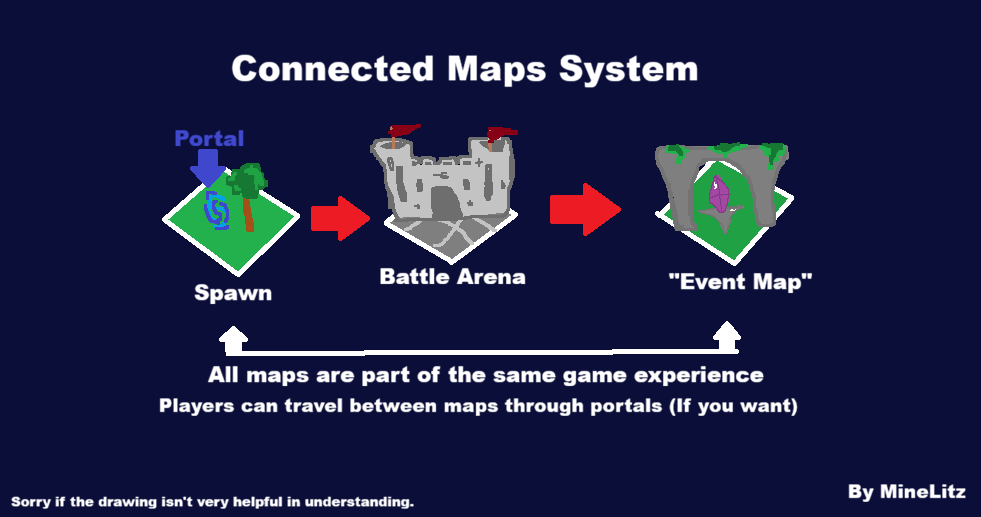
Example Structure
-
Main Hub / Spawn
-
Battle Map
-
Minigame Map
-
Event Map
-
Exploration Map
When a player interacts with a portal or another trigger, they would be automatically transferred to the selected map while remaining within the same game experience.
Benefits
-
Easier organization for large projects.
-
Simpler content updates without modifying existing maps.
-
Ability to create central hubs that connect multiple game modes.
Possible Implementation
Developers could use Lua scripting to handle map transfers, allowing custom conditions such as level requirements, permissions, matchmaking systems, event access, and automatic teleports.
Inspiration
-
Roblox’s multi-place experiences
-
Team Fortress 2’s separate maps for different gameplay modes
-
MMORPGs that connect different areas through portals and transitions
Why This Would Be Useful
This feature would allow developers to create much larger and more immersive experiences by connecting different maps together. For example, a parkour game could gradually send players to harder stages as they progress, a story game could move players between chapters and locations, and an RPG could have separate towns, dungeons, and boss areas connected as part of the same adventure.
It would also make hub-based games possible, where players start in a central lobby and choose between different modes, events, or activities. Rather than being limited to a single map, creators could build experiences that grow over time with new areas to discover, making games feel bigger, more organized, and more engaging for players.
This feature would make it possible to create much larger and more ambitious games in Blokoto, including RPGs, open-world adventures, social hubs, and minigame collections, while maintaining good performance and scalability.